
tock tock tick
Revised 2021
224 pages
Note: copies ordered from Kinnebrew Studios are signed by the author.
The listed books are available, some from different sources and Kinnebrew Studios Publishing.
For orders or additional information:
Contact KINNEBREW STUDIO PUBLISHING
siristruble@gmail.com
(269) 967-3241
HUCKLEBERRY MOUNTAIN
33 MILBURN LANE
HENDERSONVILLE, NORTH CAROLINA 28792
$18.00 Click to purchase
link to return to the book main page
Author’s Disclaimer
I am not a scientist. I am an artist, a seeker, a Person of Curiosity (POC). I ask questions. I have few, if any, reliable answers. Many of these questions seem unessential to most others, particularly those concerning quality, sensibility, or, at times, their possible outcomes. I often get enmeshed in a web of wondering and my own ignorance. Those who are the “elsewhere experts” can help, but so too can philosophers who usually do not agree with scientists and vice versa. I am standing in the middle, at the edge of the net for those who dare to fall while the game proceeds. I wish to be more than an observer in the stands. I am not a referee.
This book was not written for experts at the time. There is much for them to pick at here and perhaps be amused or outraged by such circular meanderings. Such journeys are the mindful artifacts of creative endeavors. Please accept that, as in my paintings, I propose nothing to force acceptance; I simply share the sights and sounds of places I have been. Like you, I will save some for another day of reflection and never-ending search for enlightenment. Our brains are wonderful things, and I remain grateful for mine.
Time is the most often used noun in the English language. To emphasize the point, the word time is italicized throughout the text.
In this book, I confess to having cherry-picked information for reasons of personal curiosity and, perhaps, your entertainment. To be honest, I seek contradictions to our assumptions and our actions. How we view them is fair game. If I have erred in my ways, I apologize in the name of narcissism and irony.
I am not always a smart aleck, as one humorless person suggested. On occasion, I do take some pleasure in tweaking noses. Being a surrealist down to my toes, I put things together in unconventional ways, which the droll, humorless observer obviously does/did not. That is why he is vanilla, and I am Butter Crunch.
Blaine, Washington
2021
P.S.: When I started writing this book, I imagined using it in a classroom or for a series of lectures. I would also like to have written the textbook for it, created tests, and suggested topics for further discussion, because, in time, all these things would be necessary.
Sadly, I shall never have this opportunity because others will tell me time is short, they don’t have enough of it, and my time is not that important to them. Hence, I have written down and recorded my thoughts about time, my own time, so I don’t forget and now go forward in time to develop them further.
Cheers for the time being!
_____________________
Timekeepers note
Sundial
First used in Mesopotamia in c. 3500 BC, the time stick – a primitive form of sundial – was the first “clock” ever developed by Man. Consisting simply of a long stick planted in the earth, it told the time by casting a shadow on the ground that changed length and position as the Sun “moved” overhead.
Time passed as it is wont to do, and another creative notable entry appeared. Before the birth of Christ, the Antikythera Mechanism (an-ti-KEE-thur-a) was a complex, whirling clockwork instrument with more than 30 bronze gears and thousands of interlocking tiny teeth. Using a single hand crank, it tracked the passage of time and the changing positions of celestial bodies with great precision. Dials counted the days using three different calendars, one for calculating the timing of the Olympics. Around its front face, pointers representing the stars and planets revolved dramatically, showing their position relative to Earth. A tiny, painted model of the moon rotated on a slender axis, its black-and-white tones replicating the moon’s waxing and waning.
With all these moving parts, the Antikythera was without question the most advanced piece of machinery found in ancient Greece and at the time the known western world. It would not be until the 14th century that geared clocks were built in Europe.
Reviews:
By his own admission, Kinnebrew is surrealist down to his toes. In Tick Tock, he delivers a prismatic analysis of “time” inviting us on a journey that Dali, DaVinci and Einstein would applaud. Tick Tock serves up a smorgasbord of essays that provokes, enlightens and entertains. Thomas P. Rigoli, Silicon Valley Veteran
Use these links to view individual books
Fiction
little boys, big dreams & the hobo wars
_______________________
Nonfiction
________________________
Art Books
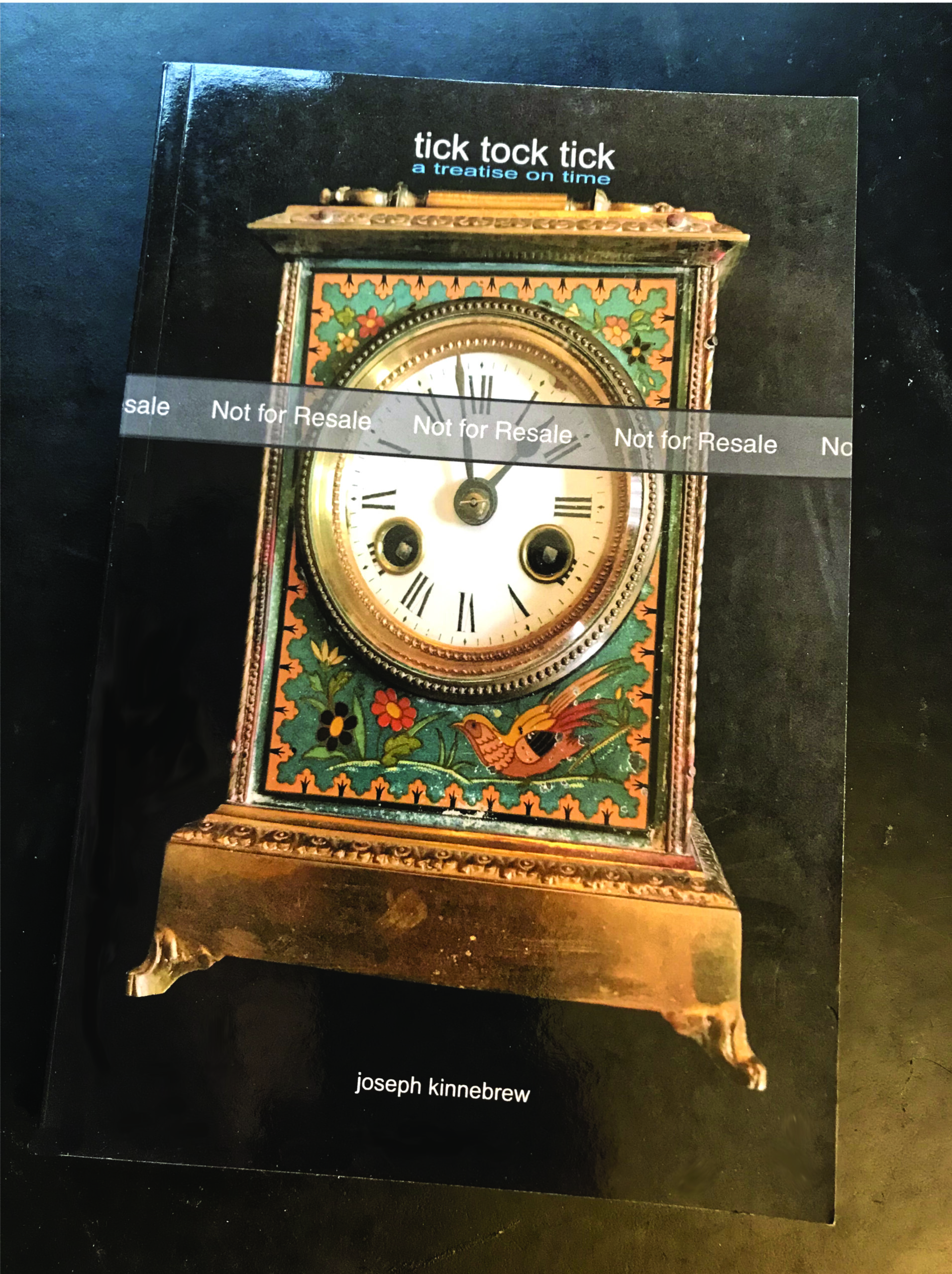
Antique chiming Chinese clock from Kinnebrw collection
Description:
Preface
I like to think, which is why I focus on time. I especially like to think about time just before falling asleep. Sometimes it keeps me awake for quite some time, and in the dark, I reach over for my iPhone to write myself a note for the morning. The bright light of the phone plays hell with my circadian rhythms.
It started one day, when I wondered if there was a present. The more I thought about “it” (that being time itself), the clearer “it” became. The present was an utter impossibility; it was a full stop, but that is not what actually happens, or so we think. Actually, nothing stops, but that’s for later, another time.
Having pushed the future immediately into the past, one moment morphs into another. Oh, and there are many times ahead with many also behind. On another sleep-deprived night, reverse seemed the only way “it” could be. There could be no such thing as past and future; there is/was only the present, my first contradiction and the timeless conundrum regarding time.
The big question is, how do you go about substantiating an idea about such a fundamental concept? Is it too obvious, easy, simple, or irrelevant? Seems the first step was to acknowledge that time is a human concept. The second might be: can you see time? Then warp it, weave it, eat it, broker it, wrap it around a tree, and so on?
There is nothing to suggest the cosmos needs or has any awareness of time. This is like asking, “Does the cosmos, which comprises all galaxies, need God?” That too is a good place to start, because where does one go to ask and to whom, and as long as you’re at it, what do you ask about time’s awareness? Is time aware? This is to say nothing about what kind of answer you get. If you want to limit this to exclusively human perception, then stop reading right now. What I am trying to do is go beyond myself, perhaps wondering about wondering itself. As an artist, maybe that is what is causing me this mental dust-up; we (artists) are curious about such things.
Wondering what it would be like with no time is rough stuff. It is like being in the middle of a pyrotechnic, the moment it bursts. Well, more than that, really, because at or in the aerial burst, when it happens and explodes in all directions, it is more like being out at the furthest end of each individual burn object, or better described as an event, and then following it back to the source. Ground. Entropy seems lost here, reversed, lost once having hit the ground at a dead stop. Stopped entropy is a contradiction in terms, raising another idea… is entropy time?
No time at all. We only have the present (time), nothing else matters so what was time for anyway? Humans measure, and I have a quirk about measuring things. It’s been a secret for most of my life. I can tell you within days when I will most likely need a new bar of soap or tube of toothpaste; I have measured such things and make notes. Plenty of science relies on measuring, so does cooking, your computer, and our daily schedule. Who really invented time?
Sundials were used around 3500 B.C., basically a stick in the ground and a moving shadow. In 1908, Canadians were the first to use Daylight Saving Time. Darkness is more of an issue the further north you go. This said, it is not known who invented time; apparently, it just came upon us as a reality, an awareness (whatever that is and is written in an upcoming book. Aside from those investigating human consciousness, I do not know anyone who has suggested we debate this idea, but I am.
Is there a relationship between the reality of time showing up for and by popular demand for AI? Maybe.
Was time there all along, just waiting to be discovered or acknowledged, maybe used like perspective and shadow were in art? Perhaps, but I don’t think so. I think mankind needed to memorialize things and combine that with their craving for immortality. Just as they invented deities, they invented time to keep track and throw markers on the field. Humans liked to measure, but it certainly took them a long time to bring time into the picture. Clocks, the timekeeping escapement, or mechanical device, were invented by the polymath Su Sung about 1000 AD. Prior to that, there were somewhat unreliable water clocks, but suffice it to say, time was well established long before 1000 AD. There was the Greek Antikythera about 2100 years ago.
Back to existence without time. Physics says time began with the Big Bang. For the moment, I leave what happened before that alone (I have written about that in “Before the Sun”). For now, I borrow from John Rennie, the Editor-in-Chief of Scientific American.
The problem is that, as we trace back to the Big Bang, the metric grows without limit; at the Big Bang, it becomes infinite. You can’t do arithmetic with infinity. It might be fun to speculate what ∞ times 0 is, but when this sort of expression crops up in physics, it means we have to admit we can’t calculate what’s going on. This is why you’ll often hear it said that time started at the Big Bang. It’s because we can’t calculate backwards in time from that point. Now that doesn’t necessarily mean there was no time before the Big Bang; it just means we have no way to calculate it within General Relativity. If you believe in Loop Quantum Cosmology, it predicts a Big Bang bounce, allowing us to follow geodesics back through it and into an earlier universe. However, this is highly speculative.
My comment: It simply means we have no way to calculate it within General Relativity. Now here is a troublesome point. The history of science is a tale of constantly changing one’s mind… more information = more change. Very few things have remained constant throughout the history of science, so this reliance on the “Theory of General Relativity” is very questionable business… problem is, what else have we got for the present…please re-read the last part of the previous sentence… “what else have we got for the present” and drill in on that word PRESENT!
This is science talking, not about the cosmos, because for obvious reasons, like no matter what, and we via SETI are listening, “they” tell you about chatting with God, still nobody has yet talked to the cosmos. We are, so far, on our own with this one. If we are alone and nobody’s feelings are getting hurt, it seems fair game to pull the rug out from under the paradigm. I’m no physicist again, but that doesn’t stop me from committing heresy, back to “no” time.
No past, present, or future. We just are, or “is.” I call this the “it.” It is just “it.” No time, no more worries about being early or late, no more thinking about when you arrived, or that your time is up. You are just no longer “it” or “is,” you transitioned to “were.” That is, if you believe in the past. That explains a lot of what people have been thinking about forever. This idea of no time has some appeal for perfectly good reasons. Spring just happens, daffodils just happen. After the yaddaa new child just happens.
It is time for no time.
“Me thinks I am like a man, who having struck on many shoals, and having narrowly escap’d shipwreck in passing a small frith has yet the temerity to put out to sea in the same leaky weather-beaten vessel, and even carries his ambition so far as to think of compassing the globe under these disadvantageous circumstances.”
-David Hume, A Treatise of Human Nature (1739-40)
The International Union of Geological Sciences (IUGS) has termed our age the Holocene Epoch, which began after the last major ice age 11,700 years ago. More recently, some have suggested we rename our time the Anthropocene. (We might do this, except most cannot spell it correctly) Geologists call this the impact humans had on Earth.
__________________________________________
Note: copies ordered from Kinnebrew Studios are signed by the author.
Alllisted books are available, some from different sources and Kinnebrew Studios Publishing.
For orders or additional information:
Contact KINNEBREW STUDIO PUBLISHING
siristruble@gmail.com
(269) 967-3241
HUCKLEBERRY MOUNTAIN
33 MILBURN LANE
HENDERSONVILLE, NORTH CAROLINA 28792